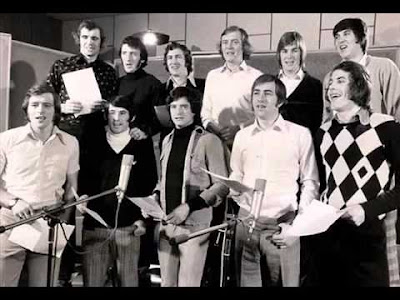
(Image credit of The Football History Boys website – now at: www.tfhbs.com )
WordPress gave the option of trying out their AI generated podcast, this morning. Of course, you can’t hear the songs that are mentioned in the proper post, and the voices are certainly not Scottish!
I know what some readers think of this (well, one contributor at least – am I right John Allan? 😉) but it’d be interesting to have more feedback in the Comments below.
This is just an experiment – it will be fun to see how many people listen to the post in addition to / instead of reading it.
_____
Pip: World Cup season means one thing is absolutely guaranteed — football opinions, delivered at volume, from every direction. This site delivers.
Mara: Cee Tee Jackson has been digging into the culture around the 2026 World Cup, and today we’re spending our time on one very specific and very joyful corner of football history: the squad song.
Pip: Let’s start with the vinyl, the jingoism, and the surprisingly good stories behind it all.
Back Home in the 1970s, Futbol was Easy, Easy.
Pip: So the premise here is that World Cup 2026 has a problem, and it isn’t VAR — though VAR does get a mention — it’s the near-total absence of official squad songs. The post is essentially a love letter to an era when countries pressed actual seven-inch singles to mark their tournament participation.
Mara: The setup is direct. The post describes these songs as “usually a stomping mix of overt jingoism, balanced with a heavy load of self deprecation,” often performed by the playing squad itself, sometimes with a well-known personality added in.
Pip: That description does a lot of work. It captures exactly why those songs were simultaneously embarrassing and beloved — the self-awareness was baked in from the start.
Mara: And the post makes clear this wasn’t a UK-only habit. The compilation spans three World Cups across four continents. Peru’s 1970 entry, “Peru Campion” by Ases del Peru, dynamically listed the entire starting lineup in its rhythm, immortalizing players like Teófilo Cubillas on vinyl.
Pip: Which is a genuinely charming idea — your name, in the song, forever. Beats a squad photo.
Mara: Brazil’s “Pra Frente,” written by Miguel Gustavo, came out of a contest to decide the national anthem and sold massively. England’s “Back Home” gets warm treatment too — notable partly because it was written by Scottish songwriter Bill Martin alongside Phil Coulter, the pair also responsible for “Puppet on a String” and “Congratulations.”
Pip: Scotland not at Mexico ’70, but Scotland’s fingerprints on England’s anthem. That’s a very particular kind of participation.
Mara: The 1974 entries include West Germany’s “Fußball ist unser Leben,” which the post places in a specific memory — watching the final in a German Bierkeller in Spain, the song on repeat, fans “giving it laldy.” Poland’s entry, Maryla Rodowicz’s “Futbol,” wasn’t written for the team but was performed live at the opening ceremony in Munich — a significant moment during the Cold War era.
Pip: And then Scotland’s own 1974 entry: “Easy, Easy” by the Scotland Football Squad, glam rock, charted at number twenty, and released to celebrate a tournament where Scotland became the first side ever eliminated at the group stage without losing a game.
Mara: The 1978 section adds Argentina’s “Marcha del Mundial ’78,” which has a remarkable backstory — FIFA hired Ennio Morricone to compose the official anthem, his instrumental didn’t connect with fans, and the B-side ended up adopted instead. The Netherlands entry, recorded by comedian Andre Van Duin with the squad, became a massive anthem despite — the post notes with a wink — Scotland beating them with “THAT” goal.
Pip: The undisputed highlight of the 1978 section is Andy Cameron’s “Ally’s Tartan Army” — over 360,000 copies sold, eight weeks in the charts, peaked at number six. The post calls it “probably the ultimate, quintessential football fans’ World Cup anthem.”
Mara: And the post closes by noting that Scotland’s current 2026 offering from Belle and Sebastian captures the mood but lacks, in its own words, “that cringe factor; that cheesy refrain and dodgy barely-rhyming lyrics.” The implication being that the cringe was actually the point.
Pip: Turns out sincerity dressed as embarrassment hits differently than irony dressed as cool.
Mara: The throughline here is that football culture carries memory — in songs, in stories, in a jukebox playing on repeat in a Spanish Bierkeller in 1974.
Pip: Next time, we’ll see what else from this World Cup summer is worth pressing to vinyl, metaphorically speaking.
Discover more from
Subscribe to get the latest posts sent to your email.

